Showing posts with label bp. Show all posts

Thursday, June 10, 2010

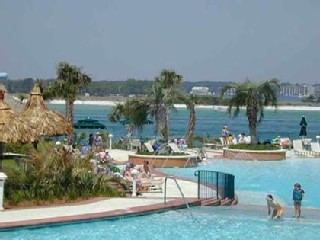
Alabama Beach Resort

0 comments
Oil from the massive spill in the Gulf has moved into the inland waterway along coastal Alabama, prompting the U.S. Coast Guard to close Perdido Pass, the main water access route for fishermen and boaters in the popular resort town of Orange Beach.

BP and the government have tried to protect the pass for weeks with thousands of feet of boom, but thick waves of oil have seeped into the pass and down the waterway, coating the marshy shoreline as it moves through.

People in the community are frustrated, watching the massive oil spill ruin, not only the once pristine beaches and turquoise water of the Gulf, but their livelihood, as well.

Chris Ybarra owns Cotton's Restaurant on Orange Beach Boulevard, the main drag through the seaside resort town that should be bustling with tourists and activities this time of year.

The beach is only about 200 yards from his building, but Ybarra said his business is dwindling.

"It's definitely on the decline. People are canceling their reservations and it's definitely beginning to hurt more than it did a month ago," he said.

Ybarra has been in business for 25 years, specializing in surf and turf, fresh seafood and steak. But that's a potential problem now that 33 percent of the Gulf in his neck of the woods is off-limits for fishing.

Ybarra said he's more fortunate than many of his neighbors, and he can easily diversify.

"If I have to go to selling freshwater catfish or primarily serving steaks or chickens, then that's something that I'm going to certainly look at to try and maintain the stability of my business," he said.

Ybarra says his friends, neighbors and fellow business owners have all faced adversity before, primarily from the devastation of hurricanes, but have always come out on top, always rebuilding and moving forward. However, he said the oil crisis is very different.

"The problem we're having with this is the uncertainty. It's very exasperating because it's like an emotional roller coaster," he said.

Ybarra said BP and the government don't seem to know how to respond to the ongoing disaster.

iReport: Track the oil disaster

"Some days they're saying it's been pushed out and it's not coming, then other days they're saying it's here," he said. "So from a resident standpoint, it's like an emotional roller coaster.

"It is taking its toll on people emotionally because a lot of folks are really attached to this community and have put their whole life and livelihood in a lot of different businesses to be able to live her and stay here and create an environment they can work in and prosper from."

Sunday, May 30, 2010

BP Top Kill

0 comments
The amount of oil spilled by BP Plc's blown-out Gulf of Mexico well has eclipsed the 1989 Exxon Valdez disaster, and could be flowing at a rate nearly four times BP's recent estimates, according to findings of a U.S. government expert panel released on Thursday.

On May 17, there were at least 130,000 barrels of oil on the surface of the Gulf of Mexico, and a similar amount had been skimmed off the surface or evaporated, according to a panel of government scientists known as the Flow Rate Technical Group.

The findings, made public by U.S. Geological Survey Director Marcia McNutt, confirm that more oil has been spilled from BP's leaking well than the estimated 257,000 barrels that fouled Alaska's Prince William Sound by the grounding of the Exxon Valdez tanker.

If the panel's calculations are accurate, a total of at least 260,000 barrels of oil had spilled into the ocean by May 17.

The high-end estimate of oil on the water that day was 270,000 barrels, with a similar amount contained or evaporated, the panel found.

McNutt declined to confirm that the BP spill has eclipsed the Exxon Valdez, but she did not dispute it.

"This is obviously a very, very significant environmental disaster and I think with the numbers I've given you, you can do the math," McNutt said.

The team's best estimate for the amount of oil pouring from the well is 12,000-19,000 barrels per day, though one of three measurement methods the team used returned a high-end rate of 25,000 barrels per day, McNutt said.

Assuming the well has flowed 12,000 barrels (504,000 gallons/1.9 million liters) a day since April 20 -- the day the Deepwater Horizon rig exploded -- the total amount of oil released by the well is 444,000 barrels (18.65 million gallons/70.59 million liters), nearly twice the amount from Exxon Valdez.

A BP spokesman declined to comment on the government's estimate.

The government's lowest estimate is over twice the estimate repeatedly cited by BP officials of about 5,000 barrels (210,000 gallons/795,000 liters), though company officials have said the estimate is unreliable.

Wednesday, May 26, 2010

Top Kill

0 comments
BP Plc's (BP.L) next attempt to stanch the flow of oil from its blown-out Gulf of Mexico well will be a delicate balancing act for engineers pumping dense fluids from the surface, and is deemed as likely to fail as succeed.

Few can offer any firm predictions about it because a "top kill," as the method is known, has never before been attempted nearly a mile beneath the ocean surface.

After more than a month of oil gushing into the Gulf, BP remains hopeful but realistic about its chances of success. The top kill could start as early as Wednesday.

The procedure will make use of tubes already on the blowout preventer (BOP) to get near the well at the bottom of the BOP. A heavy fluid known as drilling mud will be injected in a bid to reverse the well's outward flow and push the oil back down.

To pull this off, BP says it has 30,000 hydraulic horsepower of pumping capacity at its disposal.

"The real issue is can you get enough momentum against the flow of this well to actually push it back?" Dave Roberts, head of worldwide upstream operations at Marathon Oil Corp (MRO.N), told the Reuters Global Energy Summit in Houston. "I think they have the horses on the surface to take care of it."

But if the mud alone doesn't do it, BP can inject bridging material, which can include golf balls or pieces of tires, that would then be pushed up into the BOP by the oil and gas flowing out of the well.

The hope is this material gets stuck and impedes the oil flow enough to let the mud to do its job, and allow the well to be plugged with cement. The trick will be monitoring pressure levels to see whether more bridging material needs to go in to create enough of a seal, but not so much as to cause unwanted blockage.

CONCERN OVER BIGGER LEAK

"If it's wide open up to the hole, it's going to be difficult to get that pressure to build," said Pierre Conner, head of sales, trading and research at Capital One Southcoast in New Orleans, and a former drilling engineer. "Success is going to be dependent on watching those pressures."

Holden Zhang, a University of Tulsa associate professor of petroleum engineering who has a doctorate in fluid mechanics, was optimistic about the top kill working, but also highlighted the problem of the oil flow simply pushing the mud straight out the top of the BOP. "That's a possibility," he said.

Apache Corp (APA.N) Chief Executive Steve Farris, whose company operates in the shallow waters of the Gulf of Mexico, told the Energy Summit that the top kill was "doable" even if the depth and pressure pose unique challenges.

"One of their biggest concerns is to create a bigger leak than they've got right now," he said. "I don't blame them."

Conner put the chances of success at about 50 percent, but believed there was a low probability of making the situation any worse. "I don't see a lot of downside," he said.

Analysts at Tudor Pickering Holt, a Houston-based brokerage specializing in energy, see the chances of a successful top kill at less than 50 percent, worrying about the possibility of debris in the BOP impeding the injection of mud.

BP may or may not broadcast the top kill from its underwater camera, but the world should not have to wait long to find out how it goes. If the process starts at daylight, Conner said they would have some idea whether the mud was coming back up by midday.

BP does have other options if the top kill fails, including the installation of a dome along with a seal to prevent the formation of ice -- which made the last dome ineffective -- and the installation of another BOP on top of the existing one.

BP Oil Spill Live Feed

0 comments
There is so much going on in the world and not all of it is progressive. One of the things that is really depressing the environmentalists and others alike is the BP oil spill live feed which has been made public and since the making public of it the whole reality of the BP spill has come out into the open. When the platform collapsed a little more than a month ago there was no idea that there would be such a big disaster in the Gulf of Mexico, so close to the shore of America and the state which was bought from the French, Louisiana.

The spill reached the shores and it sparked a whole new level of concern amongst the citizens of the state which then eventually resulted in the BP oil spill live feed. Much of the credit goes to Ed Markey who can be considered one of the founders of the BP oil spill live feed. There are those who claim that not much can been seen through the BP oil spill live feed

but then you have to consider that the camera through which the feed is coming is based some five thousand feet underneath the surface of the Gulf of Mexico. The pipes from which the oil is leaking is on the basin of the ocean floor and there are different ideas being floated about how to contain the spill. Kevin Costner has a machine which can separate the oil from the water and he says that it has a 97 percent efficiency and that is not bad at all.
Oil spill video: First video from the blow out preventer leaks

LinkWithin

Related Posts with Thumbnails